|
|
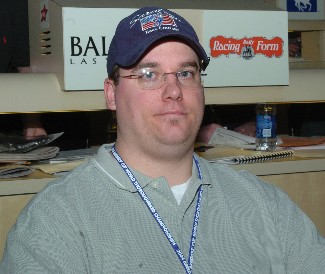
ONE-ON-ONE INTERVIEW DECEMBER 30, 2005 Handicapper Eric Isaacson by Rich Nilsen
Eric joined Brisnet.com in early 2000 and is a regular Ultimate Past Performance user. Stable Alert and Archive Result Charts are two additional tools in his handicapping arsenal. I sat down with Eric this week to discuss, among other things, his approach to handicapping. Q. Eric, you had a monster day in the Hoosier Park contest. It seemed like you were cashing nearly every race and continuing to pull away from the field as the day wore on. What were the keys to your success that day? A. Each contest has its own unique rules. One of my strong suits is contests that have all mandatory races. Knowing that we had 20 races that we had to handicap, so we didn't have to worry about 100 other races to find optional plays. So, I was able to focus my attention on the task at hand. Based on my past performances, I have certainly excelled in contests that have mandatory races. I just have something to look at and make my decisions based on those races. It's nice to go heads-up on the same races, and may the best man win. Q. What advice would you give to the average contest player? A. You have to go in there and play to win. You can't play scared. Don't be afraid to take a stand on a 10-1 shot, for example, and see what happens. The other thing is that you have to have a good game plan going into the contest, knowing generally what you will be doing throughout the day. You have to be ready and willing to adjust on the fly, depending on what happens during the contest. Your game plan may not be in effect any longer and you will have to be able to adjust - and be willing to do that. Q. How many hours per week do you put into handicapping? A. This year I have spent on average 20 hours per week, or around four hours per day on average. That would include everything from reading up on horse racing news to magazines. I will handicap actual races, and I'm working on my own speed figures for the New York tracks. I've only been handicapping seven or eight years. I read about people that have been doing it 30-plus years who are still learning. So, I know there is still a lot for me to learn. I may have come a long way at this point, but I know I can't rest on my laurels and have to continue to keep learning. Q. What do you feel are your strengths as a handicapper? A. I believe one of my biggest strengths is trying to visualize what has happened in the past to a particular horse. Maybe the horse got in a speed duel. Compare it to human terms. Let's say you preferred a certain pace as a runner but someone was pressing you to push on faster than you wanted to. Eventually, you would become disheartened, start to slow down, and not run your race. I try to relate that to the horse. How this may set up for today's race. Just visualizing what may come and what could have happened in the past. Value is another strength, especially in contests. You may think the 6-5 shot is going to win the race. That doesn't matter. You need something bigger than that if you are going to be a player. I try to use a little bit of everything. Each race presents a different puzzle and will determine what I use for the race, e.g. breeding. I will use different things for different situations. I am not going to use pedigree in a race full of accomplished runners. You have to be willing to adjust and use what is needed for the race at hand. Q. What BRIS ratings and factors do you rely on? A. I rely on the pace figures, and the breeding and pedigree stats if the race warrants it. I also like to use the track bias information, especially in contests involving tracks that I am not as familiar with. That is something that can give you insight, which can be a useful separator in choosing between two horses. Q. What are some of your goals as a handicapper? A. Going into this year I had not actually finished first in any of the tournaments, so my goal was to 'win' a contest. Moving forward, now that I have that elusive first victory, I want to continue qualifying for the Championship. The ultimate goal would be to do this as a profession. I would be a horseplayer, and that is what I would do. That is my main goal. I believe the best way for that to happen is from playing contests. I personally don't know anyone that can take $100 to the racetrack and come home with $10,000 (from wagering). But you can do that at these handicapping contests. It's not an easy road, but you keep plugging away. Q. How does the prize structure format of a tournament factor into your decision to participate? A. When it involves travels, there has to be some good money on the line. There may be a contest close to home with a poor prize structure, but I will still likely play it since my costs are low. With a local tournament I'm not having to invest in airfare, hotel, etc. Also, how many berths are available to the Championship is a factor. Fortunately, the last two years I been able to qualify early in the year, which has allowed me to pick and choose which tournaments I want to play the remainder of the year. Q. Finally, will you approach the National Handicapping Championship any differently than you would other tournaments? A. I would say no. I will go in there with the same game plan as I would with a contest given the optional/mandatory format. I will keep a closer eye on the tracks involved, so I have a better idea of any trends (track bias, winning trainers) at that track. This will give me a slight edge over the players who are not doing that. I've been there three times before, so you may think you know what's going to happen. But now I have the added mix of the $1 million bonus, so I don't know if the bonus will affect me or not. I will try to stay the course and make it happen.

 Send this article to a friend
|
|