Forgotten History: The Phipps family's two British classic wins

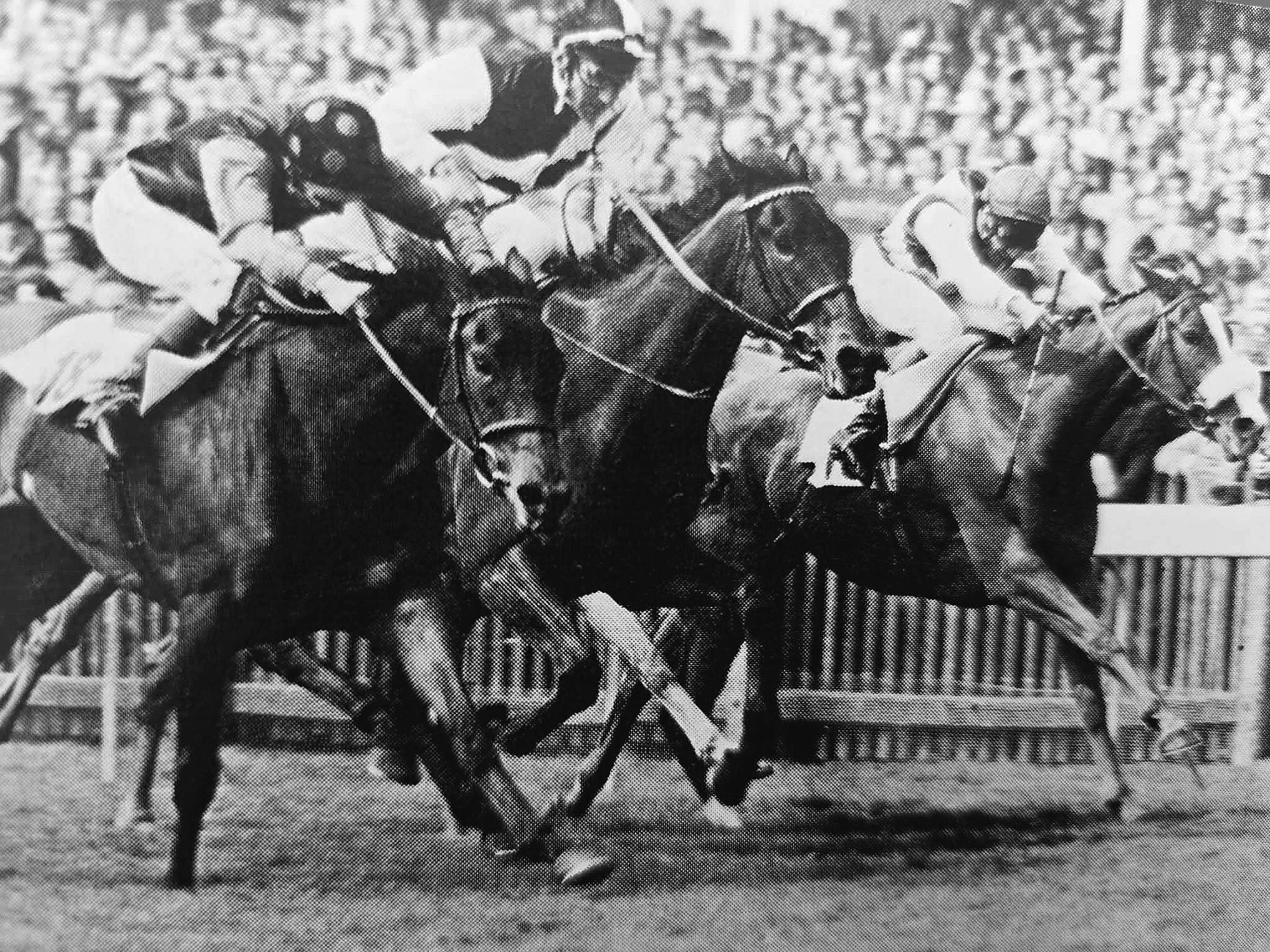
Quick as Lightning (left) wins 1980 English 1000 Guineas (Timeform Racehorses of 1981)
Golden Tempo’s victories this spring in the Kentucky Derby (G1) and shortened Belmont (G1) perhaps were serendipitous, as they fell on the 100th anniversary of the Phipps family’s involvement in Thoroughbred racing.
Despite their extraordinary successes in the breeding and racing of many champions and top-level horses over the past century, wins in the American classics have been few and far between for the Phippses. Before Golden Tempo’s dual glory, the family had achieved only one victory in each of the Triple Crown events.
Bold Ruler, the signature runner for Gladys Livingston Phipps’ Wheatley Stable, won the Preakness in 1957. Easy Goer, who, along with Buckpasser were Ogden Phipps’ best colts, emphatically captured the 1989 Belmont. And in 2013, Orb prevailed in the Kentucky Derby for Ogden Mills “Dinny” Phipps and his cousin Stuart Janney III.
Less well known, though, are the family’s two other classic wins, both of which occurred in England decades ago.
Boucher (1972 St Leger)
A *Ribot half-brother to Poker, the future broodmare sire of Seattle Slew and Silver Charm, Boucher was born and raised at Claiborne Farm but was based during his racing career with the legendary Irish horseman Vincent O’Brien.
At two, the Ogden Phipps-owned Boucher won twice in three starts, including the Beresford S. at the Curragh, which at the time was Ireland’s richest juvenile race. But in his first foray to England, for the Observer Gold Cup (now Futurity Trophy) at Doncaster, Boucher finished fourth to High Top, the eventual 2000 Guineas winner.
Despite capturing the Nijinsky S. at Leopardstown in his three-year-old debut, Boucher had to forfeit an opportunity to compete in the Epsom Derby. Uncharacteristically last as an odds-on favorite in the Chester Vase, Boucher was found to have contracted a virus and was sidelined for nearly three months.
Boucher returned in late summer and won twice, including the Desmond S. at the Curragh, and then it was on to Doncaster for the St Leger. After months of drought, a liberal watering of the course combined with a pre-meeting deluge produced heavy and treacherous ground.
Under the famed Lester Piggott, Boucher started as the 3-1 second choice. But his chances were nearly erased at the start when he was caught flat-footed and conceded his rivals about a dozen lengths.
What saved Boucher was the dawdling pace set by his rivals. Within a furlong or so, Boucher had essentially caught up with the rest of the field without having to exert much energy. The St Leger, thus, turned into a test of speed in the second half of the race.
Not entirely happy with the state of the ground himself, Boucher had to be continuously encouraged and straightened out by Piggott through the long straight. But he eventually did so, scoring by a half-length in a farcical time of 3:28.71, around 20 seconds slower than average for the extended 1 3/4 miles.
Boucher raced once more, finishing 13th of 19 in the Prix de l’Arc de Triomphe. He was eventually sold to stand stud in Australia, where he sired only one Group 1 winner. However, Boucher's daughters produced the Australian champion fillies Research and Burst.
Quick as Lightning (1980 1000 Guineas)
From the penultimate crop by 1966 Horse of the Year and Hall of Fame inductee Buckpasser, the ill-fated Quick as Lightning didn’t always live up to her moniker but prevailed when it counted.
Owned by Dinny Phipps and trained in England by John Dunlop, Quick as Lightning won two of three starts at two, including the Fillies’ Mile (G3) at Ascot. The expectation, though, was that Quick as Lightning would prove more effective over middle distances.
In her lone preliminary before the 1000 Guineas (G1) at Newmarket, the seven-furlong Fred Darling (G3) at Newbury, Quick as Lightning closed strongly to finish third after meeting trouble a quarter mile from the finish. However, she was lukewarm in the Guineas market, starting at 12-1 in a field of 23.
Under journeyman rider Brian Rouse, Quick as Lightning lagged near the back early but gradually improved position throughout the straight mile. Making the widest bid of the large group running nearest the stands’ side rail, Quick as Lightning hit the front inside the final furlong and dug in to prevail by a half-length.
Favored for the Epsom Oaks (G1), Quick as Lightning finished fourth. Her other attempt at 1 1/2 miles, the Irish Oaks (G1), was no better, dispelling notions she’d be even better at distances beyond a mile. In between the Epsom and Curragh classics, Quick as Lightning had finished third, beaten a neck, in the one-mile Coronation (G2) at Royal Ascot.
Returned home to America, Quick as Lightning ran three times for trainer Angel Penna in Florida during the winter of 1980-81. However, she was the beaten favorite each time, in the La Prevoyante H. at Calder and twice in allowance company.
Quick as Lightning tragically died in late April 1981 of a hemorrhage, shortly before she was to be bred to Nijinsky II.

Authors

Categories
FEATURED PRODUCTS
Daily Selections
Full racecard analysis/expert picks for major tracks from America's top handicappers.
Buy Nowe-ponies Picks
E-Ponies computer-based figures have been around since 1997. Using an algorithm written by the business owner and handicapper, Liam Durbin, and powered by BRIS data files, E-Ponies offers a unique, fact-based, dispassionate analysis of every horse in every race, assigning scores for speed, class, form, connections, and more. Forget which jockey owes you money! What does the data say!
Buy NowBruno With the Works
Bruno De Julio & team bring 30+ yrs experience observing racehorses to Brisnet with valuable insight into their morning routines & chances for success in the afternoons.
Buy NowValue Plays AI by Predicteform
Full race card program with easy-to-use win chances and contender classifications for every runner plus analysis of the Best Bet, Live Longshot, and Wagering Suggestions for every race.
Buy NowADVERTISEMENT